In Texas, an ICE summer operation in the Lewisville Lake area, carried out with support from state and local agencies, produced 121 arrests. The operation shows how cooperation between ICE and local law enforcement can extend federal immigration enforcement into public-safety activity within communities.
The Texas development covered here is a summer enforcement operation led by ICE’s Dallas field office in the Lewisville Lake area. ICE reported 121 arrests and said the operation also supported local investigations and safety monitoring at the lake. The agency said two of those arrested were members of the Tren de Aragua organization. ICE’s account of the operation was also reported by GnewsUSA and Golpe Político.
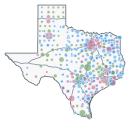
ICE currently lists 445 participating agencies in the state under 549 287(g) agreements, ranking 1st nationally by absolute agency count.
289 agencies79% of local agencies64 Warrant Service10 Jail Enforcement279 Task Force20.3M covered
Updated September 15, 2026 ·
Generated with PromptQL
Florida expanded its use of 287(g) partnerships between local law enforcement and ICE, alongside increased immigration arrests and federal funding for participating agencies. The expansion has brought scrutiny to how local jails handle people held for ICE and prompted calls in Florida communities to end or reconsider cooperation.
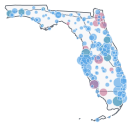
A September report said ICE had awarded about $38.6 million for equipment and transportation to Florida state and local agencies participating in 287(g) agreements. The report described the funding as covering 325 agreements and every county in Florida, underscoring how broadly the program had spread across the state. ICE’s current roster lists 289 participating agencies and 353 agreements in Florida, which ranks 2nd in the country by participating-agency count.
In Pinellas County, reporting on the Pinellas County Jail found that the facility repeatedly released and rebooked people held for ICE, allowing some to remain in county custody beyond the federal 72-hour limit. One woman spent a total of 26 days in the process, according to local reporting on 174 people being rebooked and a ProPublica investigation of the jail practice.
Miami’s 287(g) agreement, approved in 2025, faced renewed political uncertainty in 2026. As of August, the mayor said she would sign legislation ending the agreement if the city commission approved it, while commissioners continued debating whether and how to withdraw, according to coverage of pressure on the mayor and the commission.
In Tampa, community members urged the city council in August to end the city’s cooperation with ICE through its 287(g) agreement with the Tampa Police Department. The appeal added local opposition to a statewide debate over the role of police and jails in immigration enforcement, as described in coverage of the community campaign.
143 agencies5% of local agencies3 Warrant Service140 Task Force438.6K covered
Updated October 10, 2026 ·
Generated with PromptQL
Pennsylvania’s 2026 record shows a mixed local approach to ICE enforcement: some law-enforcement agencies maintained or approved 287(g)-linked cooperation while others rejected or restricted partnerships. The developments illustrate how local police decisions can shape federal immigration enforcement, producing both expanded cooperation and direct municipal resistance across the state.
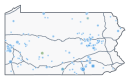
Pennsylvania’s 2026 287(g) record combines new and continuing cooperation with local efforts to limit ICE involvement. ICE’s current roster lists 143 participating agencies in Pennsylvania, the 3rd such total in the country, and 143 agreements or memorandums of understanding. The year’s developments show that those statewide figures do not describe a single local policy.
Advocates said Danville police assisted ICE, but local agencies disputed the scale and characterization of the operation. Reporting linked the episode to existing 287(g) agreements involving the Danville Police Department and the Montour County Sheriff’s Office. Further reporting on the Geisinger site and an account of the difficulty of tracking the enforcement activity documented the continuing uncertainty around what occurred.
Other Pennsylvania municipalities completed moves to block or narrow cooperation with ICE. Lansdowne, Pennsylvania, prohibited 287(g) collaboration agreements in August; Upper Darby, Pennsylvania, adopted restrictions on police assistance and data sharing in September; and Slippery Rock, Pennsylvania, rejected a proposed agreement in August. Lansdowne’s ban, Upper Darby’s restrictions, and Slippery Rock’s rejection each followed local debate over the role of municipal police.
In October, Uniontown, Pennsylvania, removed a proposed 287(g) task-force agreement from its council agenda after opposition and said it would not revisit the measure. The council’s decision added another completed local refusal to the state’s record of limits on cooperation.
A separate September case involved West York, Pennsylvania, where police stopped Haitian pastor Molis Augustave for a broken headlight and turned him over to ICE custody, according to reporting on his detention. Public pressure later led immigration officials to halt his scheduled deportation while his application for permanent residence was considered. CASA said the deportation was stopped, but Augustave remained in ICE custody.
Missouri has expanded its cooperation with ICE through a statewide 287(g) framework and new county and municipal agreements that authorize trained local officers to perform specified immigration-enforcement duties. The arrangements broaden the role of Missouri law-enforcement agencies and county jails in federal immigration enforcement while prompting demands for greater oversight of detention and local implementation.
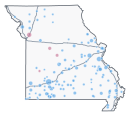
Missouri established the statewide framework last year, when Gov. Mike Kehoe issued Executive Order 25-04 and the Missouri State Highway Patrol signed an agreement allowing trained personnel to assist ICE with specified immigration-enforcement functions. ICE now lists 143 participating agencies and 158 agreements in Missouri, which ranks 3rd in the country by absolute participating-agency count. Kehoe announced the executive order in a public post.
The 287(g) expansion continued in Greene County, Missouri, where the sheriff’s office entered a Task Force Model agreement with ICE in September. The office said trained deputies may place immigration detainers at their discretion and described the agreement as an additional tool for routine law-enforcement work, rather than a general roundup operation. The Springfield Daily Citizen reported on the agreement, while additional reporting described the sheriff’s office’s stated role.
Greene County, Missouri, also continued operating its jail as an ICE detention facility. Interim Sheriff Jason Johnson said in August that he would continue the arrangement, which reporting identified as the largest ICE detention facility in Missouri; about 388 people held in ICE custody were housed there on an average day during August. Reporting on the jail partnership and accountability questions and coverage of the facility’s role also documented the scale of the arrangement.
In Nixa, Missouri, the City Council voted 5-1 in August to authorize the police department to enter ICE’s 287(g) Task Force Model. The approved arrangement would allow ICE to train selected officers to perform specified immigration functions during their regular duties. The local report on the council vote and KY3’s coverage described the proposed police partnership.
During the Sikeston Jaycee Bootheel Rodeo in Sikeston, Missouri, local law-enforcement partners working with ICE encountered people whose identification raised questions about their immigration status. ICE said three Mexican nationals were transferred into its custody after the event, which included ride-alongs with local agencies participating in 287(g). Local reporting described the detentions, and a later ICE account said three men remained in custody.
The jail partnerships also drew calls for oversight. In August, clergy and community members urged recurring independent reviews of four Missouri county jails holding people in federal immigration custody: Greene, Ozark, Phelps and Ste. Genevieve counties. The demands followed reports of a record population of people held by ICE at the Greene County Jail, according to coverage of a vigil and the oversight request.
142 agencies40% of local agencies43 Warrant Service13 Jail Enforcement123 Task Force1.3M covered
Updated September 29, 2026 ·
Generated with PromptQL
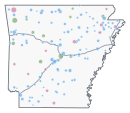
Arkansas expanded cooperation between local law enforcement and ICE through a 2025 state mandate and a broad set of 287(g) agreements, while counties created funds to support participating agencies. The arrangements have produced local detainers and immigration-enforcement activity alongside public opposition and litigation, with the responsibilities of each agency depending on its agreement.
Arkansas’s 2025 Defense Against Criminal Illegals Act requires county law-enforcement agencies to cooperate with federal immigration officers. State reporting said more than 100 Arkansas agencies had formal ICE agreements, while ICE arrests in Arkansas more than doubled from 2024 to 2025. Counties also began setting aside funds connected to the work, including through local revenue measures for an ICE program, and the developments were reported alongside the state arrest increase and one sheriff’s effort to comply with the mandate.
ICE’s current roster lists 140 participating agencies and 177 agreements in Arkansas, giving the state an absolute participating-agency rank of 4th in the country. The agreements do not all assign the same duties: some involve jail-based immigration enforcement, while others authorize participating officers to serve immigration warrants or work with ICE through the 287(g) task-force model.
Benton County, Arkansas, approved a special fund for the Benton County Sheriff’s Office’s 287(g) work in September. The action followed months of public opposition to the partnership, which began with a jail-enforcement agreement signed in 2020 before the sheriff’s office joined the task-force model in June 2026. The fund approval came after residents raised objections, and some Benton County residents had already criticized the partnership.
In Garland County, Arkansas, the sheriff’s office reported issuing more than 50 ICE detainers after the state mandate took effect. In 2026, it signed a narrower warrant-service-officer agreement; the office said the arrangement largely formalized procedures it had already been using. The initial account of the office’s compliance efforts was followed by its explanation of the more limited agreement.
Other counties tied federal funding to their 287(g) arrangements. Carroll County, Arkansas, approved a special fund after the sheriff estimated that task-force participation could bring between $250,000 and $300,000 during the 2026 fiscal year, according to the county’s report on the fund. Faulkner County, Arkansas, adopted ordinances creating special-revenue funds for the county jail and sheriff’s office to receive federal money associated with the sheriff’s 287(g) agreement.
A federal lawsuit added another challenge to local enforcement practices. Two Benton County, Arkansas, residents who are U.S. citizens sued Centerton, Arkansas, police over a 2025 traffic stop, alleging that officers detained them at the direction of federal immigration officials despite their valid identification. The case names the police chief and three officers and raises Fourth Amendment claims; documents describing the police department’s account of the stop were published after the lawsuit was filed.
The state corrections system also took on immigration-enforcement duties through an agreement with federal authorities. Under the arrangement, selected Arkansas corrections officers may question people held in ICE custody, execute immigration warrants and issue immigration detainers, extending the 287(g)-related enforcement structure beyond county law-enforcement agencies and into state corrections.
127 agencies32% of local agencies83 Warrant Service9 Jail Enforcement70 Task Force3.2M covered
Updated October 10, 2026 ·
Generated with PromptQL
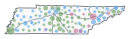
Tennessee’s partnership with ICE through the 287(g) program expanded sharply in 2026, with ICE reporting 120 state and local partners and more than 1,300 arrests by participating agencies since January 2025. A state law requires county sheriff’s offices to sign 287(g) agreements by January 1, 2027, while new local authority, joint operations and legal challenges have made immigration enforcement a broader function of Tennessee policing.
Tennessee’s 287(g) expansion moved from local agreements to a statewide enforcement system in 2026. In September, ICE reported that 120 state and local agencies were operating under the Jail Enforcement, Warrant Service Officer or Task Force models, and that participating agencies had made more than 1,300 arrests since January 2025. ICE’s account of the expansion, Spanish-language reporting on the 120 partners and a separate report on the arrests described the growth.
State law requires every county sheriff’s office to enter a 287(g) agreement by January 1, 2027, or risk losing state funding. ICE’s roster lists 127 participating agencies in Tennessee, the 6th such total in the country, and 162 agreements or memorandums of agreement.
The cooperation was also visible in Memphis, where an ICE-led multiagency operation at the El Corralón nightclub on August 30 resulted in 121 arrests. Federal officials described it as an immigration-enforcement action, while reporting found that Tennessee Bureau of Investigation warrants and Tennessee Highway Patrol support placed state resources inside it. The federal account, local reporting on the 121 arrests, coverage of the Tennessee Highway Patrol and TBI roles and advocates’ response documented the operation.
In Knox County, the sheriff’s office signed a Task Force Model agreement in September, adding authority to an existing Jail Enforcement Model partnership. Trained deputies could use immigration-enforcement authority during routine police work. More than 100 religious leaders and other community members called for the county to end the partnership, according to local coverage of the expansion and community response, a report on the sheriff’s plans and additional coverage of the agreement.
Other Tennessee counties added or broadened agreements over the summer and in September. Williamson County entered the Warrant Service Officer model; Hawkins County signed its first agreements under the Task Force and Warrant Service Officer models; and Dyer County moved from the Jail Enforcement Model to the Task Force Model. Williamson County’s agreement, Hawkins County’s first agreement and Dyer County’s shift added to the network.
118 agencies28% of local agencies7 Warrant Service5 Jail Enforcement114 Task Force745.3K covered
Updated September 29, 2026 ·
Generated with PromptQL
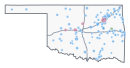
Oklahoma expanded cooperation between state and local law enforcement agencies and ICE through 287(g) agreements, contributing to more than 1,800 immigration-related arrests from January through July 2026. The arrangements have extended immigration-enforcement authority from jails and state patrol operations to local task forces, while records indicate that most people arrested had no criminal conviction and one major county proposal was rejected.
The current roster lists 118 participating agencies and 126 agreements in Oklahoma, placing the state at national rank 7th by absolute participating-agency count. The network includes jail-based arrangements, state patrol authority and local task-force agreements under the 287(g) program.
111 agencies20% of local agencies28 Warrant Service21 Jail Enforcement88 Task Force2.1M covered
Updated October 10, 2026 ·
Generated with PromptQL
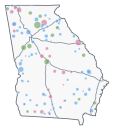
Georgia’s local-police partnership with ICE expanded in 2026 through new 287(g) agreements involving municipal and county agencies. The agreements give participating agencies defined immigration-enforcement responsibilities, while increased detainer activity and public criticism have kept the scope and effects of that cooperation under scrutiny.
Georgia’s 287(g) footprint expanded through new municipal agreements and a county sheriff’s participation, while ICE detainer data showed a measurable effect in at least one county jail. ICE’s current roster lists 111 participating agencies and 137 agreements in Georgia, placing the state at 8th nationally by participating-agency count.
The Flowery Branch, Georgia, and Oakwood, Georgia, police departments signed 287(g) Task Force Model agreements with ICE in 2026. The agreements added two municipal agencies to Georgia’s local-police immigration-enforcement partnerships, according to reporting on the two departments’ agreements.
In Forsyth County, Georgia, jail data showed a sharp increase in ICE detainers after the sheriff’s office entered an agreement with the federal agency, even as removal warrants declined. A September report on the jail data brought the practical effects of the arrangement into focus.
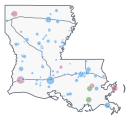
The supplied Louisiana material does not establish a specific state, county, or municipal law-enforcement agency entering, leaving, or challenging a 287(g) or other local-police partnership with ICE. Because the reported Louisiana developments concern federal detention, deportation, or ICE facilities without a documented local-police cooperation hook, no qualifying beat is included.
The material therefore contains little qualifying 287(g) news for Louisiana. That does not mean immigration enforcement is inactive in the state; it means the supplied developments do not document a local law-enforcement partnership under the 287(g) program.
ICE currently lists 94 participating agencies in the state under 103 287(g) agreements, ranking 9th nationally by absolute agency count.
80 agencies20% of local agencies9 Warrant Service11 Jail Enforcement77 Task Force1M covered
Updated October 10, 2026 ·
Generated with PromptQL
Alabama’s local and state law-enforcement cooperation with ICE expanded sharply in 2026 through new 287(g) agreements, including the state corrections system, even as some agencies narrowed or ended their participation. The shift gives more Alabama law-enforcement agencies defined immigration-enforcement roles while leaving the scope and local need for those partnerships contested.
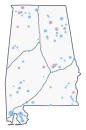
Alabama’s 287(g) expansion produced a larger statewide footprint in 2026, with new agreements involving the Alabama Department of Corrections and municipal police departments. The current roster lists 80 participating agencies and 97 agreements in Alabama, placing the state 10th in the country by participating-agency count.
The expansion was not uniform. In August, the Anniston, Alabama, Police Department withdrew from its 287(g) agreement after Chief Clint Parris said the department had not identified a demonstrated local need for the partnership. He said the department would redirect resources toward violent-crime and drug enforcement, according to local reporting on the withdrawal and additional coverage.
In September, the City Council in Tuscumbia, Alabama, approved an amendment ending the police department’s participation in the 287(g) Jail Enforcement Model. The department remained in the 287(g) Task Force Model, and officials said the jail model would require additional training and administrative work, The TimesDaily reported.
The agreements also shaped individual encounters. In September, Alabaster, Alabama, police arrested Salvadoran national Edwin Edenilson Guerrero-Dueñas during a traffic stop and transferred him to ICE custody. The Department of Homeland Security confirmed the transfer and cited his immigration status and traffic-related criminal history, according to the report on the case.
A separate Alabama traffic stop preceded the ICE detention of Elder Chavez Carranza, an Albertville, Alabama, student who had remained in immigration custody for more than 200 days. Accounts said an officer questioned him about identification and immigration status before ICE took custody; ABC News reported on his detention, with additional reporting and local coverage.
Human Rights Watch also reported that Alabama police stopped Teresa M. during a traffic-related encounter in June, asked about her immigration status and took her to jail before federal immigration agents transferred her into ICE custody. The account said the transfer separated her from her children, according to the organization’s report.
South Carolina law-enforcement agencies have worked with ICE through 287(g) agreements and joint immigration-enforcement operations. The documented record also includes ICE detainers sought through county authorities and reported limits on cooperation, reflecting a mixed statewide pattern of participation and resistance.
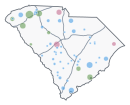
South Carolina’s 287(g) record includes formal agreements, coordinated enforcement operations and local decisions to limit cooperation with ICE. ICE lists 61 participating agencies and 68 agreements in the state, ranking South Carolina 11thth in the country by participating-agency count.
The Dorchester County Sheriff’s Office entered a 287(g) agreement with ICE in June 2025 and has been operating under it, according to reporting on the sheriff’s office agreement. The agreement placed the office among the South Carolina agencies participating in the federal 287(g) program.
In July, ICE, the South Carolina Law Enforcement Division and the State Transport Police conducted a coordinated immigration-enforcement operation on Interstate 85 in Spartanburg County. Authorities reported that 27 people were detained; local reporting on the traffic stops and additional coverage of the operation described the state and federal agencies’ involvement.
In July, ICE also lodged a detainer through South Carolina authorities for a man arrested by Greenville County officials in connection with a fatal hit-and-run. The detainer was reported in connection with the case.
The state’s record also includes limits on cooperation. A February 2025 internal email reported by FITSNews instructed North Charleston Police Department personnel not to assist ICE, documenting a local restriction on participation in federal immigration enforcement.
In a separate case, USCIS said the South Carolina Law Enforcement Division helped apprehend a person accused of impersonating a police officer and possessing firearms. ICE took the person into custody pending a deportation hearing, according to the agency’s account.
60 agencies20% of local agencies6 Warrant Service3 Jail Enforcement58 Task Force640.2K covered
Updated September 25, 2026 ·
Generated with PromptQL
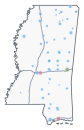
The submitted Mississippi reporting does not establish a qualifying local-police–ICE partnership or 287(g) development. Its other Mississippi stories concern detention conditions, state immigration measures, or federal court proceedings outside this brief’s local-police–ICE scope.
The submitted coverage therefore contains no qualifying Mississippi 287(g) development to report.
ICE currently lists 60 participating agencies in the state under 67 287(g) agreements, ranking 11th nationally by absolute agency count.
57 agencies16% of local agencies2 Warrant Service3 Jail Enforcement54 Task Force698.7K covered
Updated September 21, 2026 ·
Generated with PromptQL
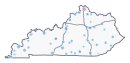
Kentucky has seen a sharp expansion of local law-enforcement cooperation with ICE, with 55 agencies reported to have 287(g) agreements in 2026 and nearly 5,000 ICE arrests recorded since the start of the Trump administration. The expansion has increased the role of Kentucky jails in federal immigration enforcement while prompting scrutiny of detainer practices, detention conditions and access to medical care.
Kentucky’s 287(g) network grew sharply in 2026, alongside a broader rise in ICE arrests carried out with help from local law enforcement. September reporting counted 55 agencies with 287(g) agreements, including 50 operating under the Task Force Model. A policy analysis, local report, Kentucky news report and Spectrum News 1 account said nearly 5,000 people had been arrested by ICE since the start of the Trump administration, including at least 257 arrests through 287(g) agreements since November 2025.
ICE’s current roster lists 57 participating agencies in Kentucky and 59 agreements, placing the state 12th in the country by absolute agency count. The 2026 expansion made county sheriffs, local police agencies and jails more direct participants in the 287(g) program, rather than leaving immigration enforcement solely to federal officers.
Louisville’s policy produced a separate increase in detainer activity. In August 2025, the city allowed its corrections department to honor ICE detainer requests for up to 48 additional hours; an ACLU of Kentucky review said at least 528 people were transferred to ICE during the policy’s first year, including 157 who were later deported. WUKY reported that detainer requests rose substantially after the change, while Spectrum News 1 covered calls to reverse the policy.
Northern Kentucky jails also remained important parts of ICE’s local enforcement network. A regional report identified a 287(g) agreement and an ICE detention contract involving Kenton County, along with detention contracts involving Boone and Campbell counties.
A federal court case in September sought the release of Beata Siemionkowicz, a lawful permanent resident who had been held at the Campbell County jail since August 2025. Her lawyers challenged her continued detention and cited reported conditions at the facility, according to an account of the case.
In January, the Boone County community group Boone County Is Better asked the fiscal court to review the jail’s cooperation in housing people arrested by ICE and sought greater transparency after a federal court ordered a bond hearing or release for one person held there. The group’s request was reported by LINK nky.
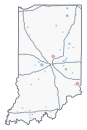
Indiana expanded its state-local role in federal immigration enforcement as the attorney general’s office entered a 287(g) agreement with ICE and a five-day operation produced 426 arrests across the state. The developments mark broader formal cooperation between Indiana law-enforcement agencies and ICE, while the authority of participating personnel remains tied to agency agreements, federal training and supervision.
Indiana’s attorney general’s office joined ICE’s 287(g) program in September, allowing designated investigators to receive federal training and perform specified immigration-enforcement functions under ICE supervision. Attorney General Todd Rokita also urged all 92 county sheriffs to pursue similar agreements. The announcement was reported by 95.3 MNC, The Indiana Lawyer, WLWT and InkFreeNews.
The agreement added the attorney general’s office to an already expanding Indiana network. ICE’s roster lists 47 participating agencies and 50 agreements in Indiana, placing the state 14th in the country by absolute participating-agency count. The roster describes the formal standing of the agencies, but each participating officer’s authority remains bounded by the relevant agreement, federal training and ICE supervision.
Indiana State Police also sought a federal grant in September for investigative technology, including covert cameras and cell-tracking equipment. The grant required an applicant to participate in, or commit to joining, ICE’s 287(g) program, but the report did not establish that the state police had completed a new agreement. The Indianapolis Star reported on the application.
Rokita’s call for broader sheriff participation drew a limited local counterpoint in southern Indiana. Some sheriffs said responding to local calls would remain their priority, even as the attorney general promoted wider 287(g) participation. WDRB reported on the sheriffs’ response.
47 agencies13% of local agencies29 Warrant Service4 Jail Enforcement25 Task Force312.7K covered
Updated September 11, 2026 ·
Generated with PromptQL
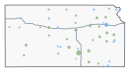
Kansas has a recorded network of local law-enforcement partnerships with ICE, and the attorney general has urged more agencies to assist with immigration operations. The September push, framed by state officials as a public-safety measure after a southwest Kansas killing, has put the scope of local participation in federal immigration enforcement at the center of the statewide debate.
Kansas’s 287(g) network includes the Kansas Bureau of Investigation, 35 counties and 10 cities, according to state officials. In September, Attorney General Kris Kobach urged more sheriff’s offices and other local law-enforcement agencies to train for and assist with ICE operations, including immigration-related detentions and the execution of deportation orders. Reports on Kobach’s appeal described the push as a call for broader cooperation between Kansas agencies and the federal government.
Kobach renewed that appeal after linking a killing in southwest Kansas to an unfulfilled deportation order. The Iola Register reported on the connection, while Salina Post and KAKE covered the attorney general’s argument that the case showed a need for greater local assistance with ICE operations.
The state’s account of existing cooperation and Kobach’s call for expansion have made local participation in the 287(g) program a statewide policy question. Kansas Press Association coverage and WIBW’s report described the September request to sheriff’s offices, while Spectrum News reported on the broader call for statewide ICE operations.
ICE currently lists 47 participating agencies in the state under 58 287(g) agreements, ranking 14th nationally by absolute agency count.
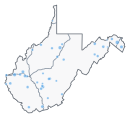
In January, West Virginia state and local law-enforcement agencies worked with ICE in a statewide operation that detained roughly 600 people over two weeks. The state later ended its role in holding people detained by ICE in local jails, while county participation in immigration enforcement continued through federally supported partnerships.
West Virginia’s statewide immigration-enforcement story was marked by Operation Country Roads, a two-week effort in January that brought state and local law-enforcement agencies into an ICE operation. The operation detained roughly 600 people, according to a review of Operation Country Roads, also published by WDC TV News, 90.5 WESA, and KNPR.
The state’s current 287(g) roster lists 43 participating agencies and 43 agreements, placing West Virginia at 16th nationally by absolute agency count. That standing reflects continued local participation even after the state’s jail system left the federal immigration-detention network.
A September regional review found that West Virginia state and local police made more arrests for ICE in 2026 than in 2025. The review of local police partnerships in the Appalachian region described West Virginia as part of an increase in immigration enforcement driven in part by local agencies; a related report provided additional detail.
After the January operation, West Virginia stopped holding people detained by ICE in its jails. Reports said that by spring the state’s jail system was no longer part of the federal immigration-detention network, even as county agencies continued participating in federally supported immigration-enforcement partnerships. Coverage of the change and reporting on the detention system documented the shift.
The Doddridge County Sheriff’s Department joined the federal partnership in February. The department later reported two immigration-related detentions and more than $137,000 in federal funding or eligible payments tied to the program, according to WV MetroNews and additional reporting on local payments.
North Carolina’s 2026 law requiring several state law-enforcement agencies to enter 287(g) agreements with ICE took effect in October, bringing designated state officers into immigration-enforcement roles during some routine duties and custodial operations. The agreements expand formal state and local cooperation with ICE beyond jail-based work, while reported street operations, legal concerns and community opposition have increased scrutiny of how that authority is used.
The Highway Patrol adopted the 287(g) Task Force Model, allowing designated and trained officers to carry out specified immigration-enforcement functions during some regular law-enforcement duties. The Department of Adult Correction’s agreement permits designated staff to take specified actions involving people in state custody. ICE’s current roster lists 31 participating agencies in North Carolina and 34 agreements, placing the state 17th in the country by absolute participating-agency count.
The Caldwell County Sheriff’s Office signed a Task Force Model agreement in September, expanding its existing 2020 jail-based 287(g) agreement. The new arrangement allows designated, trained deputies to perform specified immigration functions during regular law-enforcement work outside the detention center, according to reporting on the Caldwell County agreement and coverage of North Carolina’s county agreements.
In August, the Pikeville Police Department in Wayne County, North Carolina, signed a Task Force Model 287(g) agreement with ICE. The agreement allows designated officers to perform specified immigration functions during routine police duties and community operations, according to the report on Pikeville’s participation.
The expanded cooperation has also drawn attention to how immigration enforcement is carried out in the field. In September, the Columbus County Sheriff’s Office participated in a driver’s-license checkpoint in Tabor City, North Carolina, where ICE agents were also reported present. Siembra NC and witnesses said at least 10 people were arrested or detained and that some Latino drivers were questioned about their birthplace and immigration status; local reporting described the arrests, while another account described families searching for missing loved ones.
In Guilford County, North Carolina, a sheriff’s office detention officer was charged with 20 felony counts after investigators found allegedly forged magistrate signatures on forms used to hold people in jail for ICE. The state process requires magistrate authorization for an ICE detainer hold of up to 48 hours, according to the report on the alleged forged signatures.
North Carolina clergy and faith leaders held a prayer vigil in Raleigh, North Carolina, in August to oppose the law’s expanded cooperation with ICE. They cited concerns about officer responsibilities, public trust and the effects on immigrant communities, as coverage of the vigil reported.
New Hampshire’s local police–ICE partnerships expanded enforcement activity in 2026, with local agencies accounting for nearly half of 198 immigration detentions recorded in the state from May through July. State law protects local agencies’ ability to enter 287(g) agreements, while lawsuits and local decisions show continuing disputes over transparency, funding, and the role of police in federal immigration enforcement.
Federal data analyzed by New Hampshire Public Radio found that local police agencies accounted for nearly half of the 198 people detained for immigration reasons in New Hampshire from May through July 2026. The Keene Sentinel’s report said more than 700 people had been detained in the state since the start of the second Trump administration.
ICE’s current roster lists 29 participating agencies in New Hampshire and 29 agreements. That places the state at 18th nationally by absolute participating-agency count, while the 2026 enforcement data shows that local partnerships have had a measurable role in people being arrested and detained by ICE.
In August, the ACLU of New Hampshire sued the Division of State Police under the state’s Right-to-Know Law, alleging that the agency had not timely provided records about its 287(g) agreement with ICE. The agreement allows trained state troopers to assist with federal immigration enforcement, according to NHPR’s report; the Concord Monitor and InDepthNH.org also reported on the case.
A law enacted last year and effective January 1, 2026, bars New Hampshire, its counties, municipalities and other political subdivisions from prohibiting or impeding local agencies from entering 287(g) agreements with ICE. The statute leaves local agencies able to decide whether to join the program but limits the state and local governments’ ability to block those agreements.
Rindge police signed a 287(g) agreement in July, giving participating officers specified immigration-enforcement powers under federal supervision, the Monadnock Ledger-Transcript reported. In September, Whitefield Police received $122,000 in federal funding through its 287(g) participation; one report said town officials described the money as restricted to equipment and technology, while the Caledonian-Record report said the Select Board did not approve a proposed purchase of replacement pistols at its initial consideration.
Local participation has also faced public and political resistance. Manchester’s Board of Mayor and Aldermen voted in August not to sign a new 287(g) agreement after the police department declined to enter the arrangement in the spring, NHPR reported.
A statewide coalition of civil-rights advocates launched a petition in July calling on New Hampshire law-enforcement agencies to end their 287(g) partnerships with ICE. WMUR reported on the petition, which was also covered by The Keene Sentinel.
ICE data cited in July attributed 15 of the 51 arrests made under New Hampshire 287(g) agreements through March 10 to Cheshire County, with Troy Police identified as the county’s only participating agency during that period. Valley News reported on the figures and Troy’s role.
In September, Keene officials issued guidance explaining the boundary between local policing and federal immigration enforcement. The police department reiterated that it had not entered a 287(g) agreement with ICE, according to the city’s frequently asked questions and local reporting.
22 agencies9% of local agencies2 Warrant Service20 Task Force984.1K covered
Updated September 21, 2026 ·
Generated with PromptQL
Virginia’s 2026 effort to end or constrain state and local police cooperation with ICE has been checked in court, leaving existing 287(g) agreements in place while the legal challenge proceeds. The ruling preserves local participation in federal immigration enforcement and leaves a divided statewide landscape in which agencies’ cooperation practices and limits remain under public and legal scrutiny.
The ruling followed actions by Gov. Abigail Spanberger and the General Assembly that moved in the opposite direction. Spanberger directed state agencies to end their 287(g) agreements, while legislation limited new local agreements; the injunction stopped the state from enforcing key restrictions on the agreements already in place. ICE’s roster lists 22 participating agencies and 22 agreements in Virginia, a total that ranks 19th nationally by participating-agency count.
The statewide dispute has left local cooperation uneven. In June, Greene County sheriff’s deputies confirmed that they worked with ICE during an enforcement operation in Ruckersville involving traffic stops and multiple arrests. The sheriff’s office did not release a total or identify the people arrested.
September FOIA records brought Loudoun County Sheriff’s Office practices under renewed scrutiny. The records documented contacts with ICE when deputies encountered people flagged by immigration warrants, including information-sharing that advocates said extended beyond the office’s previously described 287(g) Warrant Service Model. Records and community criticism described the contacts, while local reporting detailed the information exchanges.
Sheriff Mike Chapman said Loudoun County deputies do not conduct field enforcement for ICE or hold people solely on immigration detainers. He acknowledged that deputies notify ICE about certain records and encounters, a position he reiterated as the sheriff’s office and county supervisors continued their public dispute over the scope of cooperation.
Fairfax County records covering January 2025 through April 2026 showed that the county declined 615 ICE detainer requests and transferred 11 people to federal custody. County officials have defended a policy requiring a judicial warrant to hold people beyond their release, while federal officials and congressional Republicans criticized those limits on cooperation. An account of the detainer decisions and the resulting political dispute documented the divide.
In August, reporting on the Rappahannock Regional Jail found that hundreds of people later deported by ICE had previously been held there. The findings placed the regional jail’s custody practices within the broader Virginia network of local-facility cooperation with federal immigration enforcement.
Wisconsin reporting shows that ICE detention and the use of local jails increased in 2026 while cooperation between local law enforcement and ICE remained contested. Legislative and court challenges have left unresolved how Wisconsin sheriffs should handle 287(g) agreements and ICE detainers.
Wisconsin’s 287(g) landscape combined a growing detention footprint with disputes over local authority and cooperation. ICE’s current roster lists 22 participating agencies and 24 agreements in the state, placing Wisconsin at 19th nationally by absolute participating-agency count. The year’s reporting showed that the question was not only how many agencies participate, but also how sheriffs interpret their obligations to ICE.
The legal dispute over detainers also remained active. In May 2026, a federal judge rejected Wisconsin sheriffs’ attempt to move a lawsuit into federal court and sent the case back to the Wisconsin Supreme Court. The ACLU of Wisconsin brought the case on behalf of Voces de la Frontera; the organization said the ruling returned the challenge to the state court.
The Legislature added a separate unresolved question in March 2025, when the Wisconsin Assembly passed a Republican-backed measure requiring sheriffs to cooperate with ICE and hold certain people accused of crimes or risk losing state aid. Gov. Tony Evers said he would veto the bill after the Assembly sent it to the Senate, according to The Daily Cardinal’s report.
20 agencies2% of local agencies3 Warrant Service1 Jail Enforcement20 Task Force413.4K covered
Updated September 11, 2026 ·
Generated with PromptQL
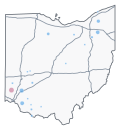
Ohio’s local law-enforcement cooperation with ICE expanded in 2026 through new and existing 287(g) partnerships, including a task-force agreement with a central Ohio police department and county jail arrangements. The agreements give participating local officers or jail officials defined roles in federal immigration enforcement, making the scope and oversight of local–ICE cooperation a statewide issue.
Ohio’s 287(g) network includes 19 participating agencies and 23 agreements, ranking 21st in the country by the number of participating agencies. The 2026 developments included a new police task-force agreement in central Ohio and county jail partnerships that gave local officials roles in federal immigration enforcement.
In July, the Utica Police Department entered a 287(g) task-force agreement with ICE. The agreement allows Utica officers to exercise limited immigration authority during routine police work and to participate in ICE-led task forces. Utica was identified as the first central Ohio law-enforcement agency with such an agreement, according to coverage of the partnership.
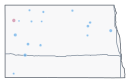
North Dakota reporting documents ICE cooperation with local law enforcement through Burleigh County sheriff assistance during Bismarck-area operations and county-jail detention of people held for immigration authorities. The documented activity shows a longstanding local-federal detention relationship being used amid increased enforcement, while available reporting does not establish a statewide expansion of 287(g) agreements.
North Dakota’s current 287(g) roster lists 17 participating agencies and 21 agreements, placing the state at 22nd nationally by participating-agency count. The available reporting does not show a new statewide expansion of the program; instead, it documents local cooperation with ICE and a continuing county-jail relationship with federal immigration authorities.
In September, Burleigh County sheriff’s deputies arrested two people after Homeland Security Investigations contacted the department about suspected immigration violations. The sheriff’s office assigned an investigator to serve as a liaison to ICE and HSI and provided additional assistance during Bismarck-area operations that produced more than a dozen bookings at the Burleigh-Morton Detention Center, according to local reporting on the arrests and operations, a report carried by KNOX News Radio, and coverage from Bismarck Source.
The Burleigh-Morton Detention Center also maintains a longstanding relationship with federal immigration authorities. Officials said in September that the facility housed about 16 to 17 people held for ICE, while beds were also being reserved for state and local prisoners; KFYR reported on the center’s relationship with ICE, and Bismarck Source described the facility’s priority for state and local holds. The arrangement shows that federal immigration custody remains part of the jail’s operations even as local and state detention needs take priority.
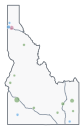
Idaho expanded its cooperation with ICE in 2026 as the state prison system and additional local agencies entered or implemented 287(g) arrangements, including warrant-service and joint-enforcement activities. The developments broaden the role of Idaho law-enforcement personnel in federal immigration enforcement while raising questions about the scope, oversight and effects of local cooperation.
Idaho’s 287(g) expansion now includes the state prison system and multiple local agencies, building on an earlier Idaho State Police task-force partnership. ICE lists 16 participating agencies and 17 agreements in Idaho, placing the state at 23rd in the country by participating-agency count. The governor’s office has described the expansion as a continuation of the state’s cooperation with federal immigration enforcement.
In August, the Idaho Department of Correction signed a 287(g) Warrant Service Officer agreement with ICE. The arrangement allows designated correction officials to serve existing ICE administrative warrants on people incarcerated in Idaho prisons and help coordinate transfers to federal custody after state sentences end, according to coverage of the new warrant-service agreement, a report on the prison partnership, the state announcement and additional reporting on the agreement. The agreement expanded the state’s earlier 287(g) work through Idaho State Police, which uses a task-force model.
In July, the Post Falls Police Department became the first municipal police department in Idaho to sign a 287(g) agreement with ICE. The warrant-service model gives designated, trained officers limited immigration-enforcement duties under ICE supervision, including serving certain administrative warrants in jail settings and helping transfer people to federal custody, as described in local coverage of the agreement, an explanation of what the arrangement allows and reporting on the department’s partnership.
Post Falls, Idaho, later reported that officers arrested 15 people in connection with immigration violations after the partnership began operating. Thirteen arrests occurred during joint operations conducted as officers completed onboarding and training in August, followed by two more during regular duties later that month, according to the department’s reported arrest total and follow-up coverage. The department said the training-period total might not reflect its later operations.
The Clearwater County, Idaho, Sheriff’s Office signed a 287(g) Warrant Service Officer agreement in August and said selected personnel had completed the required training and implementation process. Sheriff John Smith said the arrangement applies to people already in county custody who are subject to qualifying federal immigration warrants, according to local reporting on the agreement and coverage from the county’s regional press.
Records reported in August showed the Canyon County, Idaho, misdemeanor probation department coordinating with ICE from May through July. Staff reviewed case files to compile a list of 82 foreign-born people on probation and notified agents about at least one probation appointment, according to the records-based report. The records did not establish that every person on the list lacked lawful immigration status, and heavily redacted emails left unclear whether ICE detained the person connected to the reported appointment.
The Ada County, Idaho, Sheriff’s Office also adopted the 287(g) Warrant Service Officer model. Sheriff Matt Clifford described it as the least impactful option for the agency; participating personnel are limited to serving certain immigration warrants for people already in the agency’s custody under ICE oversight, according to an account of Idaho’s 287(g) involvement.
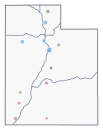
Law enforcement participation in the 287(g) program grew across Utah over the past year, bringing the statewide total to 13 participating agencies. The expansion of local cooperation with federal immigration authorities drew significant public pushback during county commission meetings and sparked transparency concerns as several departments declined to detail their enforcement operations.
A series of county-level immigration enforcement partnerships took effect around the same time. Weber County formalized an agreement to join the program, and Wasatch County became the ninth sheriff's office in the state to sign a cooperation pact with federal authorities in early August 2025.
Also that August, the Riverton Police Department announced it had signed a 287(g) Task Force agreement, marking the first time a municipal police department in the state formally joined the program.
Despite the growing number of local agreements, the Utah Sheriffs' Association expressed frustration with ICE later that summer after federal officials attempted to directly recruit local deputies for immigration operations without first coordinating with county sheriffs.
Rounding out the state's federal cooperation efforts, the Utah National Guard sought volunteers last year to assist the Department of Homeland Security and ICE with logistical and administrative support. ICE now lists 13 participating agencies in Utah, the 22nd such total in the country. However, transparency concerns persist; as of this summer, local media reports indicated that most participating law enforcement agencies declined to publicly discuss how their 287(g) partnerships function in practice.
Nebraska expanded cooperation with ICE through state law-enforcement assistance, an ICE detention facility in former state corrections infrastructure, and a local 287(g) agreement that gives a county sheriff immigration-enforcement authority. The arrangements have produced an operational network for transfers and detention while prompting protests, a legislative challenge, and scrutiny of informal information-sharing between local law enforcement and ICE.
Nebraska’s immigration-enforcement network expanded through state cooperation with ICE, local participation in the 287(g) program and the use of former state corrections infrastructure to hold people in ICE custody. ICE’s current roster lists 14 participating agencies and 16 agreements in Nebraska, ranking the state 25th nationally by participating-agency count. In 2025, state officials directed the Nebraska State Patrol to assist ICE with immigration enforcement, while the state allowed ICE to use a former prison facility that later held hundreds of people. A report on the state’s arrangement with ICE and the McCook facility documented the broader partnership.
In May 2025, ICE approved a Task Force Model 287(g) agreement with the Wheeler County Sheriff’s Office. The agreement was reported as Nebraska’s second 287(g) agreement and the first in the state under a model that allows participating local officers to perform specified immigration-enforcement functions under federal supervision. Coverage of Wheeler County’s agreement and a Spanish-language report on the sheriff’s office joining the task force described the deal.
Douglas County, Nebraska, added a different layer of cooperation in September 2026. Reporting found that the Douglas County Sheriff’s Office had referred some cases to ICE based on identifiers such as missing licenses or prior names, despite having no formal ICE contract. Nebraska State Patrol officials also said troopers had taken custody of 38 Douglas County inmates for ICE before their release from the county jail, while the sheriff floated having the county jail hold people in ICE custody. Flatwater Free Press reported on the referrals and proposed jail arrangement, with The Reader’s coverage and additional reporting from Nebraska outlets detailing the arrangements.
The McCook arrangement also drew a legislative challenge. A Nebraska bill reported in January 2026 sought to void the state’s ICE partnership at the former prison, adding a formal attempt to halt the detention arrangement to the protests and other opposition. The Nebraska Examiner reported on the bill.
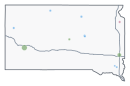
South Dakota has expanded its cooperation with ICE through the Highway Patrol’s 287(g) agreement, with state officials reporting immigration-related arrests and new federal financial support. The documented arrangement places state law-enforcement resources in federal immigration enforcement while tying its continuation to federal funding and recorded operational results.
South Dakota’s current 287(g) roster lists 14 participating agencies, placing the state 25th nationally by absolute agency count. The statewide partnership has produced reported arrests and federal payments for the Highway Patrol, while the governor’s office has continued to publicly document the arrangement’s results.
In October, South Dakota announced about $480,000 in additional federal funding and reported that the Highway Patrol’s immigration-related arrest total had reached 261. The update was covered by South Dakota Searchlight and KOTA Radio.
The governor also extended National Guard support for ICE through 2027, according to KOTA-TV’s report on the extension. Together, the funding announcements, arrest figures and continued state support show how South Dakota’s 287(g) cooperation has moved from a signed partnership to an ongoing state-backed enforcement operation.
14 agencies20% of local agencies7 Warrant Service2 Jail Enforcement11 Task Force104.7K covered
Updated September 18, 2026 ·
Generated with PromptQL
Wyoming expanded cooperation between local law enforcement and ICE through 287(g) agreements, detainer transfers and jail cooperation, including authority for trained state troopers to act during traffic and commercial-vehicle enforcement. The arrangements have increased the reach of immigration enforcement while prompting documented concerns about criminal investigations, public procedure and legal authority, with challenges and reviews still unfolding statewide.
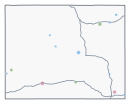
Wyoming’s 287(g) expansion included state-level participation as well as sheriff and jail partnerships. ICE’s current roster lists 14 participating agencies and 20 agreements in the state, placing Wyoming 25thth nationally by absolute participating-agency count. The developments have extended immigration enforcement into traffic stops, commercial-vehicle inspections, county jails and local criminal cases.
In August, ICE described a 287(g) Task Force agreement with the Wyoming Highway Patrol that allows trained troopers to perform certain immigration-enforcement functions during traffic stops and commercial-vehicle inspections. The initial rollout involved a limited number of troopers in five Wyoming counties, according to ICE’s announcement and description of the state partnerships, an account of the Highway Patrol chief’s explanation, and additional reporting on the arrangement.
The legality of existing local agreements remained contested in Laramie County. A judge dismissed a challenge to the sheriff’s three 287(g) agreements with ICE, and the ACLU of Wyoming said in September that it would appeal to the Wyoming Supreme Court. The lawsuit alleged that the agreements were signed without required county authorization or public input; the dismissal and the underlying challenge, records-related concerns raised by the ACLU, and the planned appeal left the question of the sheriff’s authority unresolved.
Records from Campbell County showed how the enforcement arrangements affected people arrested on local charges. County law-enforcement agencies transferred 87 people to ICE custody from May 2025 through early June 2026, mostly after nonviolent or traffic-related arrests; the records indicated that roughly half did not face District Court charges. Reporting on the transfers, a review of cases that were not prosecuted, and local coverage of the records found that some transfers complicated investigations of violent offenses.
Laramie County’s partnership also reached cases that began with the Cheyenne and Pine Bluffs police departments. Those departments did not have comparable 287(g) agreements, but they sometimes sought assistance from ICE-certified county deputies. An examination of that wider enforcement reach described how county participation could affect cases originating with municipal agencies; regional reporting also documented the arrangement.
In Teton County, commissioners approved $70,000 in July for an independent assessment of the sheriff’s immigration-enforcement policies. The county prosecutor said the legality of holding people for up to 48 hours so they could be transferred to ICE remained unsettled, as coverage of the county-funded review and the 48-hour holds reported.
Last year, the Uinta County sheriff’s office and jail took part in holding a father after an ICE operation in neighboring Idaho. The jail kept him while he pursued a legal challenge to his continued detention, according to reporting on the case.
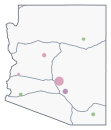
Arizona's local immigration enforcement landscape is driven by the implementation of Proposition 314, a voter-approved measure empowering state and local police to arrest suspected unauthorized immigrants. While a federal judge allowed the state law to take effect for now, local 287(g) partnerships—which currently include 9 participating agencies statewide—have faced pushback elsewhere, highlighted by a court blocking a unilateral agreement in Pinal County and the state challenging federal funding conditions.
The statewide enforcement landscape hinges on Proposition 314, a voter-approved measure that authorizes state and local police to arrest people who cross the border outside legal ports of entry and allows state judges to order deportations. In July, a federal judge declined to temporarily block the law. The judge ruled it was too early to issue an injunction because no people had yet been arrested under its provisions, despite a lawsuit from civil rights groups arguing the scheme unconstitutionally usurps federal immigration authority.
Local participation in delegated immigration enforcement remains a focus in the courts, as ICE now lists 9 participating agencies in Arizona, the 27th such total in the country. Earlier this year, a Maricopa County Superior Court judge struck down a unilateral 287(g) task force agreement signed by the Pinal County Attorney, ruling that the official lacked the legal authority to enter the ICE partnership without approval from the county Board of Supervisors.
The state government also pushed back against federal enforcement mandates. Arizona Attorney General Kris Mayes joined a coalition of states in a federal lawsuit challenging the Trump administration's policy of withholding homeland security and emergency management grants from jurisdictions that refuse to comply with federal immigration priorities.
Elsewhere in the state, a conservative legal group sued Governor Katie Hobbs in July over her administration's launch of a website informing Arizonans of their rights during ICE encounters, seeking public records on the taxpayer funds used to create the resource. The launch follows tension this spring, when federal immigration officials at a Phoenix border security exposition warned of increased operations and collateral arrests in Arizona cities that decline to cooperate with ICE, prompting public pushback from Tucson's mayor and local congressional representatives.
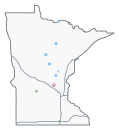
A federal judge has upheld Minnesota's local limits on immigration enforcement, striking down a Justice Department lawsuit that sought to force the state and several major jurisdictions to honor ICE detainers. Even as state and city leaders successfully defended their non-cooperation policies, sheriffs in eight rural Minnesota counties signed 287(g) agreements last year to partner with federal agents, sparking ongoing civil rights lawsuits and community pushback.
Even as the state successfully defended its non-cooperation policies in court, ICE currently lists 9 participating agencies in Minnesota, which is the 27th highest total in the country. Over the course of last year, sheriffs in eight rural Minnesota counties—Cass, Crow Wing, Freeborn, Itasca, Jackson, Kandiyohi, Mille Lacs and Sherburne—signed 287(g) agreements to formally delegate certain federal immigration enforcement functions to their local deputies. The moves prompted immediate pushback across the state.
Late last year, the ACLU of Minnesota filed a lawsuit against Freeborn County, Minnesota, challenging its entry into the 287(g) program. Civil rights advocates argue that the partnership violates state law by allowing county jails to hold people suspected of non-immigration offenses longer than normally permitted in order to facilitate transfers into ICE custody.
The legality of the agreements has also drawn scrutiny at the local government level. In February, commissioners in Kandiyohi County, Minnesota, formally reviewed the 287(g) contract signed by the county sheriff, acting on a state attorney general's opinion that raised questions about the partnership’s validity.
Community opposition has continued over the summer, as residents and civil rights organizers packed a board meeting in Crow Wing County, Minnesota, to protest the local sheriff's office's 287(g) task-force agreement with ICE.
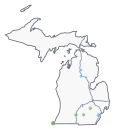
Several Michigan law enforcement agencies have signed 287(g) agreements to assist federal immigration enforcement, drawing both new federal funding and organized community resistance. While jurisdictions like Livingston and Jackson counties adopted the Warrant Service Officer model, other local ICE partnerships have faced grassroots pushback, federal lawsuits, or cancellations due to staffing constraints.
Michigan has seen a steady expansion of local law enforcement partnerships with federal immigration authorities over the past year. ICE currently lists 8 participating agencies in the state, which ranks 30th nationwide for active agreements. The most recent addition came over the summer, when the Livingston County Sheriff's Office signed a 287(g) Warrant Service Officer agreement. The arrangement authorizes designated deputies to serve federal administrative warrants on people already held in the county jail.
Not all recent partnerships have endured. The Metro Police Authority of Genesee County also signed a Task Force agreement last summer, but the police chief rescinded the partnership in October of last year, citing department staffing shortages.
Local ICE partnerships have prompted organized community pushback across multiple jurisdictions. Earlier this year, residents and advocates in Berrien County and the Saginaw County village of Oakley held protests and town halls urging local officials to terminate their law enforcement agreements with ICE.
Meanwhile, the federal government filed a lawsuit against Washtenaw County over the spring, challenging local policies that restrict law enforcement cooperation with federal immigration agents.
8 agencies6% of local agencies3 Warrant Service5 Task Force125K covered
Updated September 18, 2026 ·
Generated with PromptQL
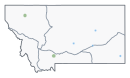
Montana’s documented local cooperation with federal immigration enforcement centers on Gallatin County’s 287(g) agreement, which was paused during litigation, while Helena adopted limits on police assistance to federal immigration agents. The disputes have produced state-level investigations and court challenges over how much authority Montana counties and cities must provide to federal immigration officials.
Montana’s 287(g) activity and related disputes have centered on local governments’ authority to cooperate with federal immigration enforcement. This spring, Gallatin County paused operations under its agreement with ICE after residents challenged the arrangement in court and questioned whether the 2020 agreement had been properly approved.
Helena took a different approach to local cooperation. In January, the city adopted a resolution restricting how its police assist federal immigration officials; in February, Gov. Greg Gianforte and Attorney General Austin Knudsen announced a state investigation into whether the policy violated Montana law. The state investigation added a state-level challenge to the dispute over municipal limits on assistance to federal agents.
The Gallatin County conflict has also continued through the county attorney’s office. Audrey Cromwell has contested demands from Knudsen concerning local cooperation with federal immigration enforcement and declined to provide confidential county criminal-justice information requested by federal immigration officials. The dispute is before the Montana Supreme Court, according to an interview with Cromwell and a separate account of her conflict with ICE.
ICE currently lists 8 participating agencies in the state under 8 287(g) agreements, ranking 30th nationally by absolute agency count.
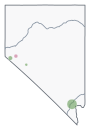
Nevada's local law enforcement partnerships with federal immigration authorities have expanded since last year, pushing the state to 4 participating agencies as the Las Vegas Metropolitan Police Department and Douglas County entered 287(g) agreements. The renewed local cooperation has sparked legal battles, including a pending Nevada Supreme Court challenge over the Las Vegas agreement, as state leaders publicly clash over the extent of local police authority in immigration enforcement.
ICE currently lists 4 participating agencies in Nevada, giving the state the 33rd such total in the country. The federal footprint grew noticeably last year when two major law enforcement agencies signed new 287(g) jail agreements, reversing a multi-year lull in program expansion and reigniting debates over local police involvement in deportations.
In May of last year, the Las Vegas Metropolitan Police Department entered a 287(g) agreement with ICE for the Clark County Detention Center. The partnership authorizes local officers to serve civil immigration warrants and hold people in custody for up to 48 hours for federal agents. Between the program's launch and the beginning of this year, the department reported facilitating more than 1,150 ICE arrests at the facility, drawing intense scrutiny from civil rights advocates.
The Las Vegas signing followed a similar move in northern Nevada, where the Douglas County Sheriff's Office signed a 287(g) jail enforcement agreement in February of last year. The pact made Douglas County the first jurisdiction in the state to join the federal program in approximately five years.
The sudden expansion prompted legal challenges, culminating when the ACLU of Nevada sued the Las Vegas Metropolitan Police Department late last year. The civil rights group argued that the agency's 287(g) agreement violates state law and erodes the judicial system. A state court judge dismissed the lawsuit earlier this year, prompting the organization to appeal the case to the Nevada Supreme Court this spring.
State leaders remain publicly divided over local immigration enforcement. Under a 2021 state law, the Nevada attorney general issued guidance advising local agencies to focus on crime prevention rather than immigration enforcement. In contrast, the governor maintains that Nevada is not a sanctuary state and insists that local authorities will continue to cooperate with federal immigration agents.
Despite the formalized jail agreements, direct cooperation in the field has encountered friction. Over the summer, Las Vegas municipal police intervened during an attempted ICE apprehension at Harry Reid International Airport. Local officers removed handcuffs from an elderly man detained by federal agents after determining there was no active arrest warrant or legal basis for local police to hold him.
5 agencies1% of local agencies1 Warrant Service5 Task Force29.1K covered
Updated September 21, 2026 ·
Generated with PromptQL
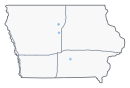
Iowa’s documented cooperation with ICE includes a state 287(g) task-force agreement and later reported involvement by local law enforcement in traffic enforcement and ICE detention. The record reflects a mix of formal federal delegation, jail-based cooperation and disputed enforcement practices, alongside at least one county decision not to enter a federal immigration-enforcement pact.
Iowa’s formal 287(g) cooperation began last year, when the Iowa Department of Public Safety signed a memorandum of agreement with ICE. The agreement created a three-member task force whose assigned duties could include identifying, questioning and arresting people for alleged violations of federal immigration law, according to a report on the agreement.
ICE’s current roster lists 5 participating agencies in Iowa and 6 agreements. By absolute participating-agency count, Iowa ranks 32nd in the country.
In July, immigrant-rights group Escucha Mi Voz Iowa said Iowa State Patrol officers asked drivers about their immigration status during traffic stops. The group also said ICE later detained a North Liberty, Iowa, resident after a stop on Interstate 80, describing the episode as alleged cooperation between the agencies; one report detailed the allegations, while another carried the group’s account.
County jails have also remained part of Iowa’s cooperation with federal immigration authorities. The Linn County Sheriff’s Office reported that the county jail had booked 424 people held for ICE from January through July and housed 49 people in ICE custody as of July 29, according to local reporting on the jail’s records.
The state’s counties have not taken a uniform approach. In May last year, Dubuque County Sheriff Joe Kennedy said the county would not sign a federal pact involving local participation in immigration enforcement, citing concerns about county revenue and jail capacity, according to a report on the decision.
New Mexico banned 287(g) agreements and local ICE detention contracts statewide following the passage of the Immigrant Safety Act earlier this year. The state attorney general filed lawsuits against the sheriffs of Curry and Torrance counties in May after they refused to terminate their local immigration enforcement partnerships in defiance of the new law.
The new law arrived shortly after the Sheriff's Office in Curry County, New Mexico, signed a 287(g) agreement last year, becoming the first law enforcement agency in the state to formalize a delegated-authority partnership with ICE.
Beyond this legal standoff, there is relatively little 287(g) news in New Mexico compared with most of the country. ICE currently lists 2 participating agencies in the state, which ranks 34th nationwide.
ICE lists 2 participating agencies in Alaska under 2 agreements, with most joining the 287(g) program during 2021 and a few newer additions like the statewide Alaska Department of Corrections signing on in the spring of last year. There is relatively little 287(g) news about the state compared with most of the country, but this quiet coverage does not mean immigration enforcement is absent.
There is relatively little 287(g) news reported in Alaska compared with most of the country, but the state maintains an active roster of local enforcement partnerships. Most of the state's participating agencies signed 287(g) agreements during 2021, beginning that winter with the Kodiak Police Department. A few others joined later, most notably the statewide Alaska Department of Corrections in the spring of last year. Across the state, almost all of these active partnerships take the local shape of county sheriff's offices operating under the Task Force Model.
In February, the Alaska Department of Corrections confirmed that its 287(g) agreement involves screening inmate rosters, a protocol that triggered an ICE detainer for a man booked into a correctional center in Juneau, Alaska, following a local traffic stop. Meanwhile, the Anchorage Police, Juneau Police, and Alaska State Troopers stated that they do not have formal 287(g) agreements.
In January, members of the Anchorage Assembly introduced a resolution opposing federal immigration enforcement and calling for restrictions on local cooperation, funding, and enforcement powers related to ICE operations.
The Northern Mariana Islands has seen no recent news developments involving local law enforcement partnerships under the federal 287(g) program. ICE currently lists 2 participating agencies in the territory under 2 agreements.
There is relatively little 287(g) activity and little news to report in the Northern Mariana Islands compared with most of the country. ICE currently lists 2 participating agencies in the territory operating under 2 active agreements.
While there have been no documented initiatives to deputize territorial police or corrections officers recently, a lack of 287(g) news does not mean the region is completely insulated from immigration enforcement. Jurisdictions with few or no formal delegation agreements can still see heavy federal enforcement action, as federal authorities routinely arrest and hold people in ICE custody independently of local law enforcement.
1 agency<1% of local agencies1 Jail Enforcement55.9K covered
Updated September 11, 2026 ·
Generated with PromptQL
New York put a statewide ban on 287(g) agreements and other local cooperation with ICE for civil immigration enforcement into effect in August. The measure shifts those functions back to the federal government, preserves local cooperation in criminal investigations and is now being tested in court.
New York’s Local Cops, Local Crimes Act took effect in August, barring state and local agencies from entering or maintaining 287(g) agreements with ICE for civil immigration enforcement. It also limits the use of local facilities to hold people solely for civil immigration violations, while allowing cooperation in investigations of actual crimes. The law’s rollout was reported by Sun Community News, News 10, the New York Immigration Coalition and Fox 5 New York.
Fifteen New York sheriffs sued to block the ban, arguing that the law intrudes on their authority and interferes with agreements they made with the federal government. Their challenge seeks to prevent or suspend enforcement of the prohibition, according to coverage of the lawsuit, NPR and The Journal News/lohud.
The state then sued the Rensselaer County Sheriff’s Office over its failure to dissolve a 287(g) agreement with ICE. Gov. Kathy Hochul and Attorney General Letitia James asked a court to require the agreement’s termination and declare it null and unenforceable under New York law, as described in the state’s announcement, lohud’s report and WAMC’s coverage.
ICE currently lists 1 participating agencies in the state under 1 287(g) agreements, ranking 37th nationally by absolute agency count.
Massachusetts state and local officials have actively pushed back against federal immigration enforcement this year, advancing legislation and executive guidance to limit local cooperation with ICE even as the state Department of Correction maintains Massachusetts' sole active 287(g) agreement. The friction has sparked direct institutional confrontations, including a federal lawsuit over the state's refusal to provide undercover license plates to ICE agents and a public clash between a local sheriff and federal authorities over an unhonored detainer.
ICE lists 1 participating agency in Massachusetts, the 38th such total in the country. The Massachusetts Department of Correction maintains the state's only active 287(g) agreement, a prison-deportation partnership that continues to draw criticism from advocates calling for an end to the program.
In the legislature, the state Senate advanced the Protect Act this spring to restrict ICE operations at schools, daycares, and courthouses. While moving to shield people from immigration enforcement in sensitive locations, lawmakers simultaneously rejected an amendment that would have required local authorities to honor ICE detainers for people convicted of felonies.
The pushback against federal enforcement has drawn legal challenges. Earlier this year, the U.S. Department of Justice sued Massachusetts, alleging that state policies refusing to issue undercover license plates to federal immigration agents are unconstitutional and put officers at risk.
Over the summer, Bristol County Sheriff Paul Heroux publicly condemned ICE after the federal agency accused his office of releasing a person from custody without honoring an immigration hold. The sheriff asserted that complying with the detainer would have violated state and federal law, and accused ICE of attempting to bully his department.
Colorado continues to strictly limit local law enforcement cooperation with federal immigration authorities, successfully defeating a federal lawsuit aimed at dismantling the state's sanctuary policies. The persistent friction has led major jurisdictions like Denver to formalize non-cooperation directives and actively shield residents from federal operations, even as civil rights groups pressure rural sheriffs accused of bypassing state laws to assist ICE.
Colorado maintains strict boundaries between local policing and federal immigration enforcement, keeping formal 287(g) agreements to a minimum. ICE currently lists 1 participating agencies in the state, the 38th such total in the country. In April, a federal judge upheld these state and local restrictions, dismissing a U.S. government lawsuit that sought to strike down laws limiting municipal cooperation with federal immigration authorities. The ruling preserved Colorado's sanctuary policies and rejected the federal challenge to local non-cooperation directives.
Authorities in Denver, Colorado, have maintained a strict policy of refusing to honor federal immigration detainers, declining to transfer custody for more than 270 requests since early last year. The non-cooperation stance escalated in February when the city's mayor directed local police to document ICE agents on body cameras and intervene to protect residents during federal enforcement operations.
At the state capitol, a legislative committee rejected a bill in March that would have mandated state and local police to intervene against federal immigration agents using excessive force. The measure also would have required local officers to attend immigration enforcement training.
This spring, the City Council in Aurora, Colorado, voted down a proposed memorandum of understanding that would have outlined how local police respond to calls at a privately operated federal immigration detention facility within city limits.
Away from the major metro areas, civil rights organizations and the state attorney general have targeted sheriff's offices in Mesa and Garfield counties, Colorado, for allegedly bypassing state laws to coordinate with ICE. The pushback includes a state lawsuit and formal allegations targeting local deputies who facilitated the transfer of a 19-year-old student to ICE custody following a routine traffic stop last year, prompting further legal action over local arrest practices.
The Guam Attorney General's office has designated its local investigators as federal immigration officers to facilitate local deportations. Territorial officials project the enforcement arrangement could save millions of dollars by removing noncitizens with criminal convictions.
There is relatively little 287(g) activity and little news to report in Guam compared with most of the country. ICE currently lists 1 participating agencies in the territory under 1 agreements, the 38th such total nationwide. However, a low agreement count does not mean the territory is quiet on immigration enforcement, as local officials continue to expand their direct collaboration with federal authorities.
In January, the Guam Attorney General's office announced that its local investigators are now operating as federal immigration officers. By securing this delegated enforcement authority, the office projected that removing 110 people with criminal convictions from the territory could save Guam $4.7 million. The fiscal and community impact of the enforcement arrangement subsequently drew public debate regarding the territory's approach to crime and deportation.
Federal authorities are escalating efforts to circumvent California's strict sanctuary laws, launching coordinated jail operations and spending $1.5 billion to purchase private detention centers outright. Even as state leaders and counties sue to block new federal facilities, Immigration and Customs Enforcement continues to secure administrative transfers from state prisons and navigate local resistance to maintain its enforcement footprint on the West Coast.
Federal authorities launched a multiagency initiative dubbed "Operation Guardian Angel," designed explicitly to bypass California's sanctuary policies that limit local law enforcement cooperation with federal immigration detainers. The operation aims to identify and detain people facing removal while they remain in county custody.
Despite the state's sanctuary framework, ICE continues to execute arrests at the state level. Since early last year, federal officers have apprehended more than 400 people through administrative transfers from Central Valley prisons and jails, including over 130 individuals taken into ICE custody from Avenal State Prison under limited state-cooperation allowances.
At the local level, compliance with sanctuary mandates remains uneven. Public records suggest the San Luis Obispo County Sheriff's Office may have violated state law by failing to notify at least three people of ICE inquiries before their release from the county jail.
State and local leaders are pushing back against further federal expansion. This summer, California Attorney General Rob Bonta and Santa Clara County officials sued to block the construction of a planned ICE holding facility near Gilroy. The lawsuit invokes state environmental and farmland protection laws and succeeded in temporarily pausing the project.
Existing detention centers in the state also faced scrutiny over severe operational failures. A federal judge ordered immediate reforms at the Adelanto ICE Processing Center in Southern California, finding that people held at the facility faced likely unconstitutional conditions, including inadequate access to clean water, food, and medical care. Further north, private prison operator GEO Group reached a $100,000 settlement over allegations of unsafe working conditions for people detained by ICE at the Golden State Annex in McFarland, a facility where local authorities have allowed private ICE contractors to self-police internal incident reports.
A federal judge in the Southern District of Illinois struck down state laws granting in-state tuition and financial aid to undocumented students, handing the U.S. government a victory in its broader legal campaign against the state's sanctuary policies. The ruling comes as Illinois Attorney General Kwame Raoul co-leads a multi-state lawsuit to stop the federal government from conditioning emergency grants on local assistance with immigration enforcement.
Earlier this year, three teenagers from Collinsville were apprehended by ICE agents shortly after being pulled over by local police in Christian County, Illinois. According to local reports, the Morrisonville Police Department initiated the traffic stop and transported the individuals to a nearby gas station, where plainclothes federal immigration officers subsequently took them into custody.
In Joliet, Illinois, Interim Police Chief Robert Brown publicly denied allegations that local officers assisted ICE during an enforcement operation on the city's east side. Brown addressed the City Council to refute rumors of cooperation, pushing back after residents and local officials criticized the department for allegedly facilitating the federal agency's activities in the community.
In Chicago, the City Council advanced a ballot referendum asking voters whether the city should seek financial compensation from the federal government for municipal resources expended in response to ICE operations.
Elsewhere, Illinois U.S. Representative Nikki Budzinski joined Missouri lawmakers to tour the Ste. Genevieve County Detention Center in neighboring Missouri following complaints about poor living conditions and restricted access to medical care. The county jail operates as an ICE detention facility housing people apprehended across both Missouri and southern Illinois, prompting cross-state scrutiny from lawmakers concerned about the treatment of people held in ICE custody.
New Jersey officially prohibited its local and state law enforcement agencies from entering into 287(g) agreements or cooperating with federal immigration authorities under a statewide directive signed in March. While municipalities like Maplewood have adopted further local measures to block federal agents from town property, other jurisdictions such as Stafford Township have formally urged the state to repeal its sanctuary protections over officer safety concerns.
In March, Governor Mikie Sherrill signed the Immigrant Trust Directive, a statewide measure that officially prohibits New Jersey's local law enforcement agencies from entering into 287(g) contracts or sharing non-criminal information with U.S. Immigration and Customs Enforcement. ICE currently lists 0 participating agencies and 0 active 287(g) agreements in New Jersey.
The state's new policy has faced pushback from some local jurisdictions. In July, the Stafford Township Council unanimously passed a resolution urging the state to repeal its recently enacted sanctuary laws. Officials in the township argued that restricting cooperation between local police and federal immigration authorities compromises officer safety, a stance that drew praise from legal advocacy groups opposed to the state directive.
Other municipalities have moved to strengthen local barriers against federal enforcement. Also in July, the Maplewood Township Committee passed the Immigrant Trust Act, an ordinance that prohibits federal immigration agents from conducting warrantless operations on municipal property.
Federal enforcement operations have continued in the state despite the new restrictions on local cooperation. Following July immigration sweeps that targeted people working as landscapers in Belleville, the township's mayor confirmed that local municipal authorities are not notified in advance when federal immigration agents conduct actions in their jurisdiction.
Washington state and federal immigration authorities remain locked in a contentious standoff as local agencies move to sever data-sharing pipelines and logistical support for ICE. The state's strict sanctuary policies, which tightly restrict 287(g) partnerships and limit ICE's formal footprint to 0 participating agencies statewide, have prompted federal lawsuits and ongoing friction over courthouse arrests and agents' use of facial coverings.
In May, the Department of Justice sued Washington and three other states over their refusal to issue confidential license plates for ICE vehicles, arguing the restriction endangers federal agents. The legal challenge marks a significant escalation over the state's sanctuary policies, which broadly prohibit state and local logistical cooperation with federal immigration enforcement and tightly limit formal 287(g) agreements.
A state law prohibiting law enforcement officers from wearing facial coverings during public interactions has sparked further friction with federal authorities. The masking ban drew renewed scrutiny this spring after local groups tracked plainclothes federal officers conducting arrests while masked in White Center, Washington, despite the statewide prohibition.
Beyond physical operations, state and local agencies have actively severed the data pipelines previously used by federal authorities to track immigrants. The Washington Department of Licensing revoked ICE access to a state data-search system last year after discovering agents used the platform to locate a Kirkland, Washington, resident for deportation, in violation of a data-sharing agreement.
Federal arrests at local courthouses have also prompted direct pushback from county courts and prosecutors. Chelan County, Washington, officials halted the practice of sharing court dates with federal authorities following a targeted arrest last year, while Yakima County, Washington, officials reported unmarked federal units detaining people outside local courtrooms earlier this year.
Maryland enacted the Community Trust Act to ban 287(g) agreements and restrict local law enforcement from assisting federal immigration agents, prompting the state's participating counties to sever their active ICE partnerships. The statewide limits on ICE cooperation have since triggered major legal battles, with both the U.S. Department of Justice and a coalition of 17 Republican county sheriffs suing the state to overturn the new restrictions.
By May, all nine Maryland counties that held active 287(g) partnerships with ICE either formally pulled out of the program or stopped enforcing the agreements to comply with the expiration of a 90-day grace period. ICE now lists 0 participating agencies in the state, which currently ranks 41st nationwide for active agreements.
The statewide mandate quickly drew pushback from local law enforcement. A coalition of 17 Republican sheriffs, including longtime 287(g) proponents in Harford and Frederick counties, filed a lawsuit against Gov. Wes Moore in May. The sheriffs argued that the state ban on ICE collaboration endangers public safety and places local agencies in legal jeopardy.
While the legislation faces court battles, the Maryland Attorney General's Office issued statewide guidance in July requiring local officers to use body-worn cameras during federal interactions and strictly prohibiting them from assisting federal agents with civil immigration enforcement. The limits on cooperation have already led to friction; in June, the Montgomery County Sheriff’s Office drew public condemnation from the County Council after transferring a detained person to ICE custody without completing a state-mandated review.
Tensions over immigration enforcement in Oregon are escalating as local and state officials clash over the state's sanctuary laws and cooperation with federal authorities. While the state government faces a federal lawsuit for refusing to issue covert license plates to federal agents, Douglas County has openly rejected state sanctuary policies and pledged full cooperation with Immigration and Customs Enforcement.
Although Immigration and Customs Enforcement currently lists 0 participating agencies and 0 active 287(g) agreements in Oregon, ranking 41st nationally, battles over federal immigration enforcement remain highly active across the state. Oregon's strict statewide sanctuary laws heavily restrict how local police and sheriffs can assist federal authorities, leading to escalating clashes with both defiant local jurisdictions and the federal government.
The state government is also facing direct legal challenges from federal authorities. In May, the U.S. Department of Justice filed a lawsuit against Oregon and three other states for refusing to issue confidential, covert license plates for vehicles used by ICE agents. Federal officials argued the state's restriction endangers agents and violates the Constitution, while state leaders maintained that providing the plates would violate Oregon's established limitations on facilitating federal immigration operations.
Conversely, some local governments moved to strengthen their barriers against federal cooperation. Earlier this year, the City of Portland officially codified its sanctuary city status and prohibited local law enforcement officers from concealing their identities. The policy was part of a broader municipal effort to resist participating in federal immigration sweeps.
On the operational level, communication between federal and local agencies has shown persistent strain. Late last year, federal authorities reportedly kept a local sheriff's office uninformed about ICE's involvement in a cannabis raid, highlighting the friction generated by Oregon's sanctuary mandates during joint enforcement actions.
Connecticut actively reinforced its sanctuary policies last year by passing an expanded Trust Act and enacting strict courthouse rules to further limit local law enforcement cooperation with federal immigration authorities. As ICE lists 0 participating 287(g) agencies in the state—the 41st such total in the country—state and municipal leaders have continued to develop operational safeguards and civil liability proposals to minimize local police involvement in deportations.
There is relatively little 287(g) activity in Connecticut compared with most of the country, and little news of local adoption to report. ICE currently lists 0 participating agencies in Connecticut, giving the state the 41st such total nationwide, as state leaders have actively moved to restrict local law enforcement from participating in federal immigration operations.
Last year, the Connecticut legislature passed updates to the state's Trust Act that further prevent state and local law enforcement from sharing information with or assisting federal immigration authorities. The expanded protections took effect in October following advancement in committee, extensive public testimony, and widespread debate over state cooperation with federal agents.
In September of last year, Connecticut's Supreme Court Chief Justice issued a policy prohibiting masked law enforcement officers and warrantless arrests inside state courthouses. The directive, supported by the governor, was designed to limit federal immigration enforcement and prevent arrests of people facing removal within state judicial facilities, which state leaders argued would undermine public safety.
At the municipal level, mayors and police chiefs in cities including Hartford, Connecticut, New Haven, Connecticut, and Danbury, Connecticut, held strategy sessions earlier this year. Local leaders met to discuss managing public safety and ensuring that local police minimized their involvement during anticipated federal immigration deployments.
During the first months of the year, state Republican lawmakers called for rolling back parts of the Trust Act to facilitate federal deportations. Meanwhile, state Senate Democrats introduced a proposal that would allow residents to sue federal agents for alleged civil rights violations, reinforcing the state's broader stance on limiting federal enforcement coordination.
Following revelations of unpublicized local 287(g) agreements with federal immigration authorities, Hawaii enacted landmark statewide legislation to restrict local law enforcement cooperation with ICE. The new legal protections cap over a year of sustained pushback by immigrant advocates and localities, highlighted by Maui's push to sever its ties with federal enforcement programs.
This summer, Hawaii enacted landmark legislation restricting local law enforcement agencies from participating in 287(g) agreements that assist federal deportation efforts. While the statewide legal protections follow a year of pushback against local immigration enforcement, there is relatively little 287(g) news and activity reported in Hawaii compared with most of the country. ICE currently lists 0 participating agencies in the state under 0 agreements, giving Hawaii the 41st such total nationally. However, little coverage does not mean nothing is happening, as places without formal 287(g) agreements can still see heavy immigration enforcement action.
The push for statewide restrictions accelerated early last year after reporting revealed that some local police departments maintained active agreements with ICE despite prior denials. The revelations sparked public scrutiny of the Hawaii County Police Department, whose pacts were ultimately sent to the County Council for review. Over the summer of 2025, the ACLU of Hawaii sought public records to clarify the extent of county-level cooperation with federal authorities, while Honolulu officials indicated the city would exercise "appropriate judgment" regarding immigration enforcement.
By late last year, rising arrests of people across the state prompted local advocates to demand protective policies and led lawmakers to call for a special legislative session. Earlier this year, Maui advanced measures to sever local ties with federal immigration authorities in response to federal funding initiatives and community tensions. The sustained pressure culminated this summer when Hawaii enacted landmark legislation designed to limit local agencies' involvement in ICE operations and ease the impact of federal crackdowns on people targeted for removal.
After the Wells Police Department signed Maine's first 287(g) agreement with ICE last year, several other localities and state officials moved to restrict local cooperation with federal immigration agents. Earlier this year, Governor Janet Mills refused to issue covert state license plates for ICE vehicles, and the city of Waterville formally banned its police and municipal employees from assisting in federal enforcement.
Last year, the Maine Municipal Association issued guidance to local jurisdictions after ICE began actively recruiting police departments across the state to join the 287(g) program. ICE currently lists 0 participating agencies in Maine, maintaining 0 active agreements to hold the 41st such total nationwide.
Last spring, the police department in Wells, Maine, entered into the state's first 287(g) agreement with ICE. The partnership authorizes local officers to perform certain federal immigration enforcement duties after the department formally applied to the program.
Other jurisdictions stepped back from the program following public scrutiny. The police departments in Monmouth and Winthrop, Maine, abandoned a joint application to partner with ICE last spring.
At the state level, leaders have rejected requests to facilitate federal enforcement operations. Earlier this year, Governor Janet Mills and other officials specifically refused to issue covert state license plates for ICE vehicles.
Rhode Island leaders have established new statutory protections against federal immigration enforcement and mounted legal challenges to prevent the federal government from conditioning state grants on local ICE cooperation. The statewide measures formally restrict immigration arrests at local courthouses and polling places, while the attorney general is leading a multistate coalition fighting forced compliance mandates in federal court.
There is relatively little 287(g) activity in Rhode Island compared with most of the country, and little news to report. A lack of formal partnerships does not mean the state is quiet on immigration enforcement, as localities without designated agreements can still see heavy enforcement action. ICE currently lists 0 participating agencies in the state under 0 agreements, the 41st such total nationwide. Rather than expanding local involvement, recent state action has focused on limiting municipal cooperation.
Also in July, Rhode Island Attorney General Peter Neronha filed a lawsuit in federal court challenging federal efforts to condition emergency preparedness funding on immigration enforcement cooperation. Co-leading a multistate coalition, the state argues that the Department of Homeland Security cannot lawfully force states to assist in enforcing federal immigration laws in order to receive counterterrorism and disaster response grants.
The state’s federal courts have previously ruled against similar funding conditions. Last year, the chief judge for the federal district of Rhode Island blocked the federal government from withholding transportation funds from states that refuse to participate in certain immigration enforcement actions.
At the municipal level, the Providence City Council advanced an ordinance late last year to expand prohibitions on the local police department's participation in federal immigration enforcement. The measure sought to further restrict cooperation following community concerns over local police practices, though city officials raised questions about the legality of certain provisions at the time.
Last year, Delaware enacted legislation banning local law enforcement agencies from entering into 287(g) agreements with federal immigration authorities. The statewide prohibition followed swift community backlash against a brief partnership in the town of Camden, shutting down federal efforts to recruit local departments and leaving ICE with 0 active agreements in the state.
Last year, Gov. Matt Meyer signed legislation prohibiting Delaware police departments and state law enforcement agencies from entering into 287(g) agreements with U.S. Immigration and Customs Enforcement. The statutory ban officially outlawed the partnerships across all levels of state and local government, effectively barring local officers from working as federal immigration agents. ICE currently lists 0 participating agencies in Delaware, the 41st such total in the country.
The legislative push followed a localized dispute in Camden, Delaware, where the local police department quietly signed a 287(g) agreement in the spring of 2025. The department rescinded the partnership just days after it was enacted, following intense backlash from residents and civil rights groups protesting the use of local resources to detain people in the community for federal immigration enforcement.
ICE lists 0 participating agencies in the District of Columbia under 0 287(g) agreements, though the local government officially operates as a sanctuary jurisdiction that rejects federal immigration detainers. Despite criticism and funding threats from federal authorities over that stance, the Metropolitan Police Department enacted a policy last year that permits local officers to share information with federal immigration agents.
There is relatively little 287(g) activity and little news to report in the District of Columbia compared with most of the country. ICE lists 0 participating agencies in the district under 0 287(g) agreements, the 41st such total nationwide. However, a low agreement count does not mean the district is quiet on immigration enforcement.
While the district officially identifies as a sanctuary jurisdiction, Metropolitan Police Department Chief Pamela Smith signed a decree last year that allows local police to share information with federal immigration agents. The policy drew attention as an example of how people arrested in local traffic stops or police encounters can still be routed into ICE custody without a formal 287(g) partnership.
The local government's broader sanctuary policies drew federal pushback last year. Immigration and Customs Enforcement officials criticized local authorities for rejecting federal detainers and releasing people facing charges rather than turning them over for deportation. The Department of Justice subsequently designated the district as a targeted sanctuary jurisdiction.
Vermont law enforcement agencies maintain 0 active 287(g) agreements with U.S. Immigration and Customs Enforcement, leaving the state without any local police departments formally deputized to perform federal immigration duties. While the state lacks formal federal partnerships, local authorities still occasionally intersect with federal immigration operations, such as when state police were deployed to clear demonstrators blocking an ICE workspace in July.
There is relatively little 287(g) activity in Vermont compared with most of the country, and little news to report on the program. ICE currently lists 0 participating law enforcement agencies in the state, which holds 0 active 287(g) agreements overall. As of last year, Vermont remained without a single active or pending federal deputization contract on the books.
However, the absence of formal 287(g) partnerships does not mean local authorities never intersect with federal immigration enforcement. In July, the Vermont State Police and the Williston Police Department arrested 13 people on trespassing charges after they refused orders to leave a private office building that houses an ICE workspace in Williston, Vermont.